kluster, our own site
a bird of glass, flying through a day.
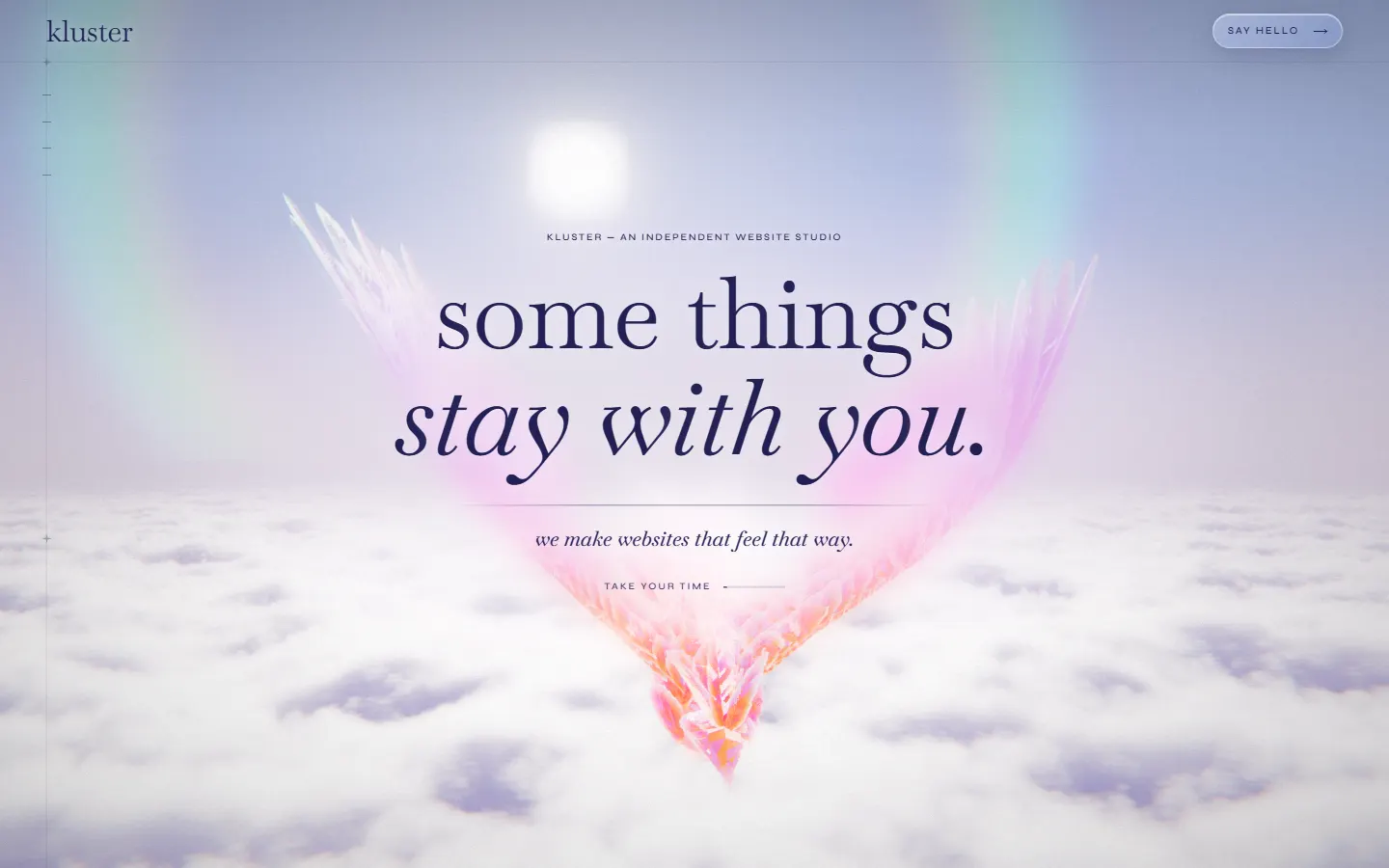
The Kluster website is our own: one real-time WebGL scene in which a bird of more than three hundred glass feathers flies from morning to moonlight as you scroll. It is built with Three.js and custom shaders, and the page times real frames to pick its own quality level.
at a glance
- Client
- Kluster, our own site
- We made
- The design and build of the site and its real-time scene
- Built with
- Three.js, custom GLSL shaders, React, TypeScript and Vite
- Quality levels
- Nine, chosen by timing real frames
- Status
- Live at kluster.fyi
What the site has to do
A studio’s own website is the sample it cannot blame on a client. Ours has to show the kind of work we make by being an example of it, on whatever device someone happens to open it with.
It also has to do the plain things. It has to say what the studio does in words a search engine can read, and let someone with no interest in birds send an inquiry.
The direction
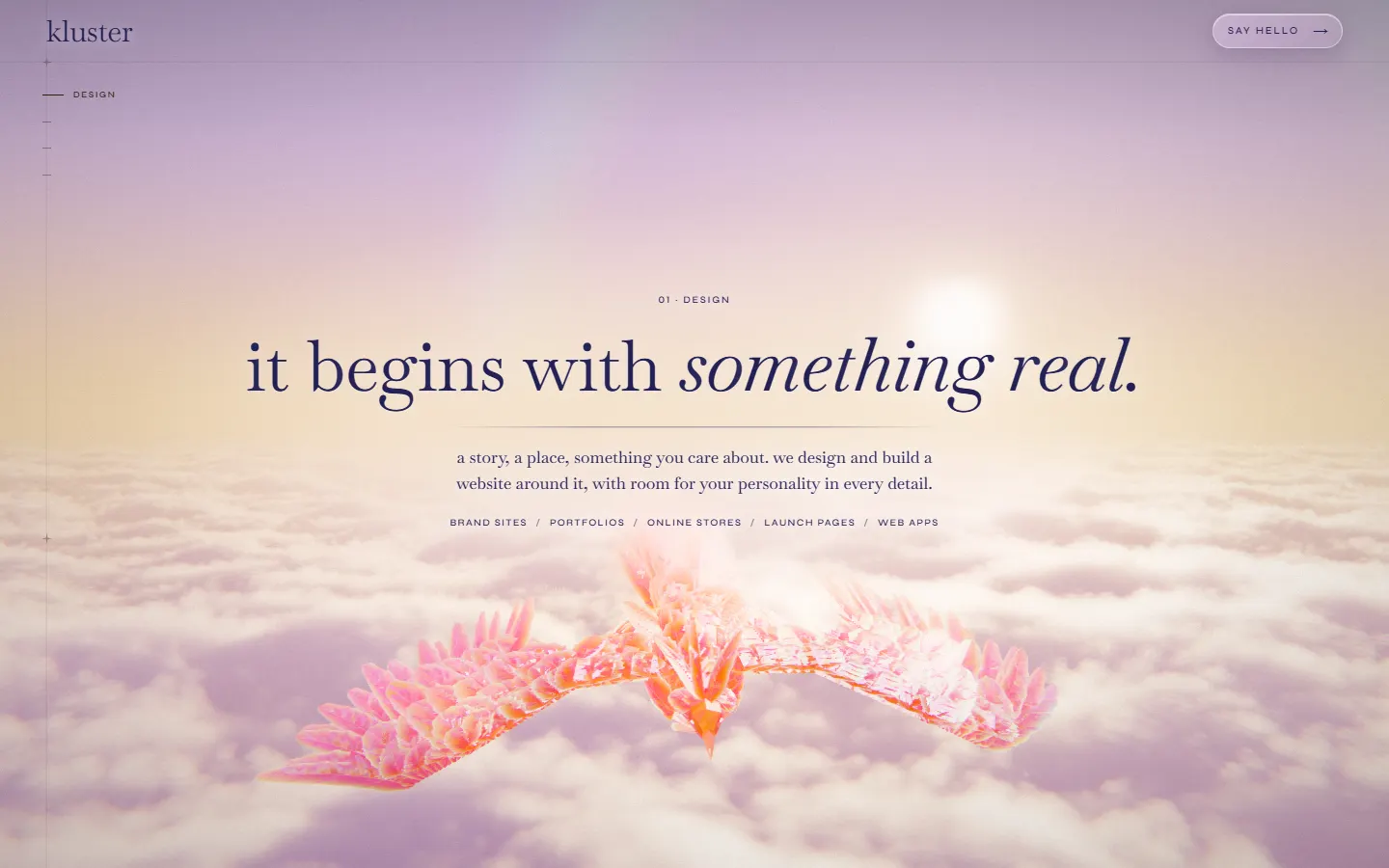
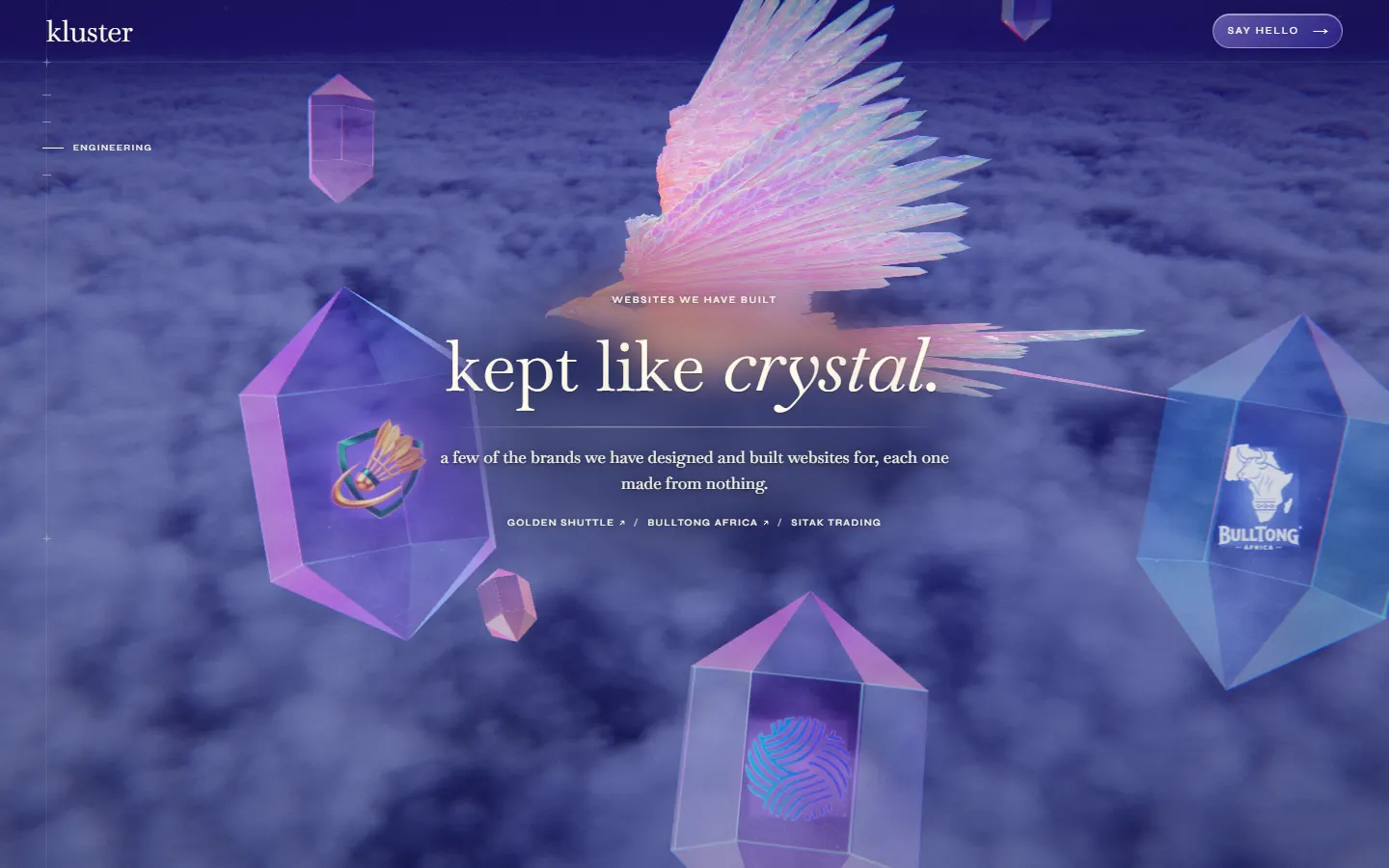
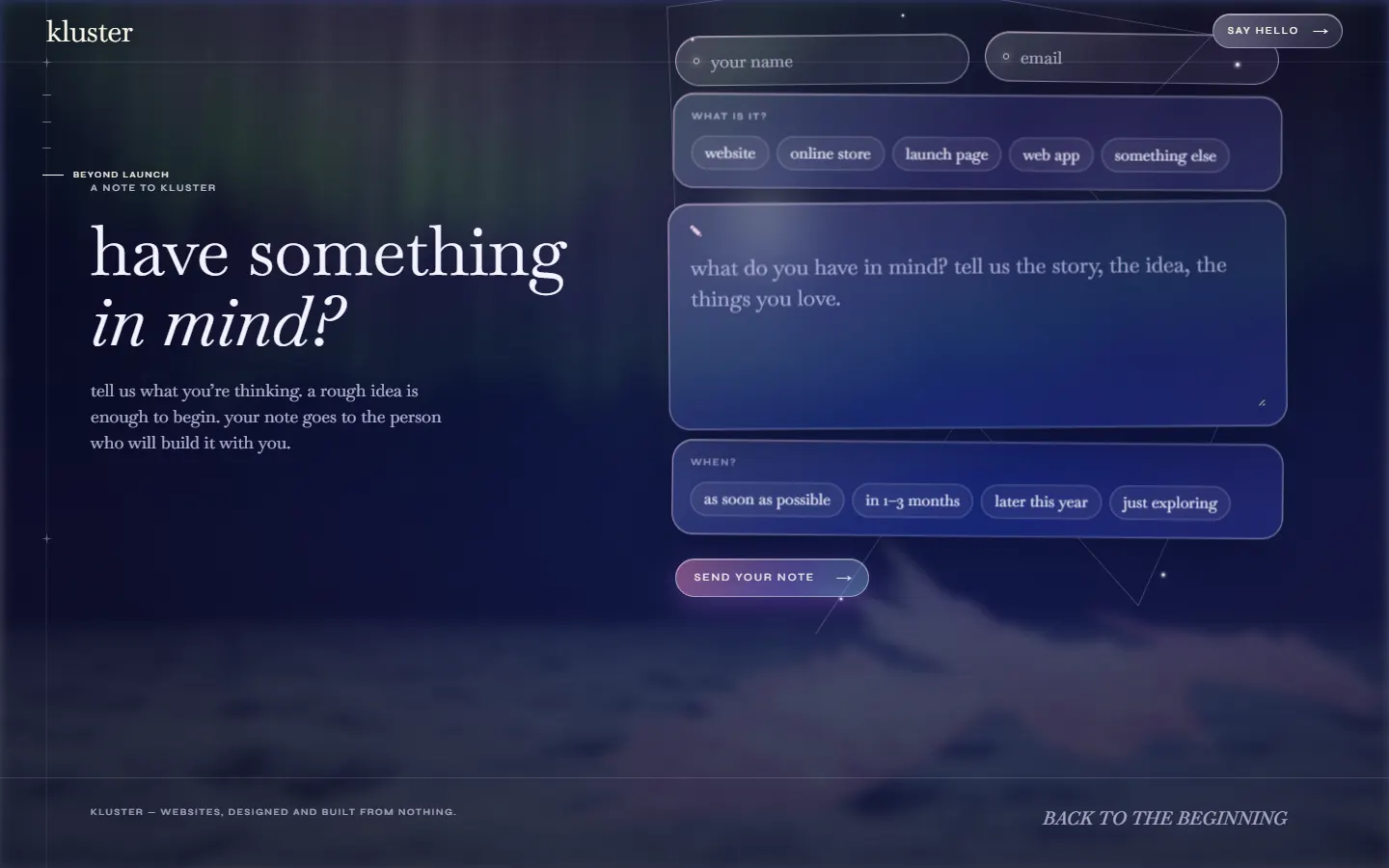
One day, from morning to moonlight. Each chapter of how we work has its own light: design at golden hour, iterating at sunset, engineering at twilight, then the work itself at night, among crystals that hold the names of brands we have worked with. At the end the inquiry cards rise over the sky, which blurs and loses some of its colour so you can read them.
The bird is more than three hundred cut-glass feathers on a small skeleton, with a carved crystal head. Its colours follow the time of day, and at twilight the feather shafts show through the glass like an x-ray.
How it works
The clouds are ray-marched in a full-screen fragment shader, at between 0.22 and 0.5 of the canvas size depending on the quality level. Each ray skips through clear air to the upper surface of the cloud, then steps through it, up to 96 times at the finest levels and 32 at the lightest, with a dithered start so that the steps do not band. Three density samples towards the sun or moon give the self-shadowing, a two-lobe Henyey-Greenstein phase function gives the glow at the edges, and the shape comes from a baked 3D noise texture.
The feathers are generated procedurally as curved, twisted blades and drawn as one instanced mesh, in three passes: depth for the nearest layer, everything behind it accumulated with weighted blended order-independent transparency, then the nearest layer drawn solid, refracting the scene with chromatic dispersion.
Scroll position becomes a story progress from 0 to 1, and a pure function of that number returns the whole pose, from twenty keyframes joined by non-uniform Catmull-Rom curves. The stage reports each frame back to the page, which sets the words, the chapter rail and the ink colour from what the picture is actually showing. React does not re-render while scrolling.
Before the page shows, every shader is compiled and the heaviest stretch, the skim across the clouds, is played for up to 3.5 seconds while real frames are timed. The page settles on the finest of nine quality levels that holds about 60 frames a second, then keeps adjusting: down if frames run late, back up after three steady seconds, and any step down that does not speed frames by at least 10% is taken back.

What it does, case by case
On phones
Judged by the device, not the window. Phones start at the third of the nine levels and stop at the fifth, with simpler feathers, half the glitter, smaller noise textures and no multisampling. On narrow screens the camera pulls back and centres the bird, because the words sit low.
With reduced motion
The camera does not fly. It cuts to one fixed still per chapter, six in all, with time and the wings frozen.
If the scene cannot start
No WebGL context, a shader that fails to compile, a startup past twenty seconds or a black-frame check that fails: any of these hides the canvas and leaves a painted sky in CSS, with the words and the inquiry cards still working.
If the graphics context is lost
The page asks for it back and rebuilds one quality level lower, over the painted sky. After three losses it stays painted.
For search engines, and without JavaScript
Every page is rendered to HTML when the site is built, and Three.js arrives in its own chunk, so the words paint before it does. Without JavaScript, the same words are laid out as one page.
Where it stands
You are on it. Everything described here is running at kluster.fyi, and the home page is there to scroll.
We have no traffic figures to give you, and we do not publish frame rates because they depend on the device in front of you. What we describe is how it works, which anyone can check by visiting it.
want a sky of your own?
It need not be a sky. Tell us what you have in mind, and we can talk about what it would take.
say hello