You have one example. Why trust it?
It is a fair doubt, and one project does prove less than ten. What it can show you is depth: open this site, read how it is made, and see whether it does what we say.
3d web experiences
A 3D web experience is a scene drawn in real time on the visitor’s own device, using WebGL and Three.js, with the camera moving as they scroll. We build them for businesses in Dubai and across the UAE, and the example we can show you so far is this website.
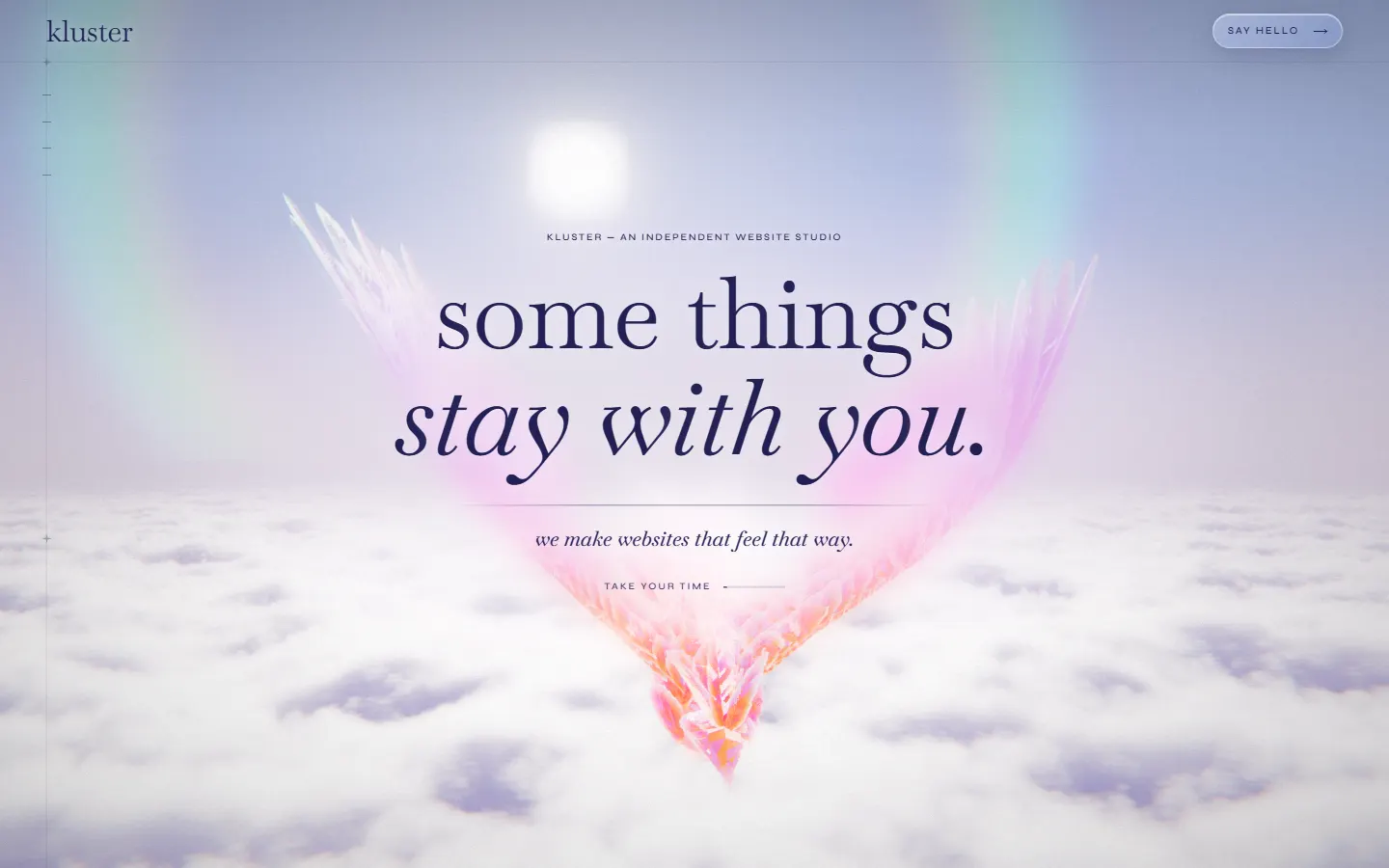
We have built one of these so far, and it is this site. We would sooner show you that one properly than imply a longer list. The home page is a single real-time scene: a bird of more than three hundred glass feathers flies from morning to moonlight, over clouds that are calculated as it goes.
The clouds are ray-marched in a fragment shader, each ray reading a baked 3D noise texture and sampling towards the sun or moon so that the clouds shade themselves. If you came here looking for Three.js website developers, the person you talk to is the person who builds the scene.
A good part of the work is deciding what happens when the scene cannot run. Without that, a WebGL website is a black rectangle on somebody’s phone.
A product people should turn over, a place, a world made for a launch. If a photograph would lose something, a scene has a reason to exist.
You want the site itself to be what people mention afterwards, and you accept a heavier page in exchange.
We have one 3D project and it is our own. If you need to see this done for a client in your industry, we cannot show you that yet.
A real-time scene costs download size and attention. A clear page with good words will serve most businesses better, and we make those too.
Custom GLSL, with no post-processing library. The clouds use a two-lobe Henyey-Greenstein phase function for the glow along their edges.
More than three hundred procedurally generated feathers, drawn as one instanced mesh, with weighted blended transparency for the layers behind and chromatic dispersion in the layer in front.
Scrolling sets a story position, and a pure function of that position gives the whole pose: twenty keyframes for height, speed, camera, roll and wing, joined by non-uniform Catmull-Rom curves.
The page compiles every shader first, then times real frames over its heaviest stretch for up to three and a half seconds and settles on the finest of nine levels holding about 60 frames a second. It keeps adjusting as it runs.
Phones are identified by the device. They draw simpler feathers and half the glitter, and on narrow screens the camera pulls back and centres the bird. It will not look identical everywhere, by design.
This is the stack under the sky on this site. A different scene might call for a different set.
A scene needs a reason before it needs a mesh. Ours is a day passing, with a stretch of light for each chapter of how we work.
You see the scene in motion and we talk. Colours, camera and pace move one conversation at a time.
Quality levels, phone settings, stills for reduced motion, a painted fallback.
Browsers and graphics drivers change, and we keep caring for a website long after it goes live.
It is a fair doubt, and one project does prove less than ten. What it can show you is depth: open this site, read how it is made, and see whether it does what we say.
It is heavier than an ordinary page, and the code is written on that assumption. Phones start at the third of the nine quality levels and stop at the fifth, with no multisampling, and the page keeps timing real frames as it runs. We do not publish frame rates, because they depend on the device in your hand.
Yes. Every page on this site is rendered to HTML when it is built, so the words, headings and links are in the first response from the server, before any script runs. Three.js arrives afterwards in its own chunk, and written pages like this one do not load it at all.
The camera stops flying. The page cuts to one fixed still for each of its six chapters, with time and the wings frozen.
The canvas goes and a painted sky in CSS takes its place, with all the words and the form working. The same happens if a shader fails, if startup passes twenty seconds or if a check of the first frames comes back black.
Both depend on the scene, so we price it after a first conversation. There is no rate card and no standard schedule for work like this.
If you have something that needs three dimensions, tell us what it is and who it is for, and we can talk about whether a scene is the right answer.
say hello