Do you build stores on anything other than Shopify?
No. It is the platform we work on and the only one we can show you. If you are set on something else, a specialist in that platform will serve you better.
online stores
We design and build custom Shopify themes, so a store keeps Shopify’s checkout and order handling while everything customers see is made for that brand. This suits shops in Dubai and across the UAE whose products need more explaining than a standard theme allows.
Our store work is on Shopify. It holds the products, the orders and the payments, and we have no wish to reinvent those. What we make is the theme: the pages, the sections and the small behaviours a customer actually meets. If you are looking for custom e-commerce in the UAE, this is the form it takes with us.
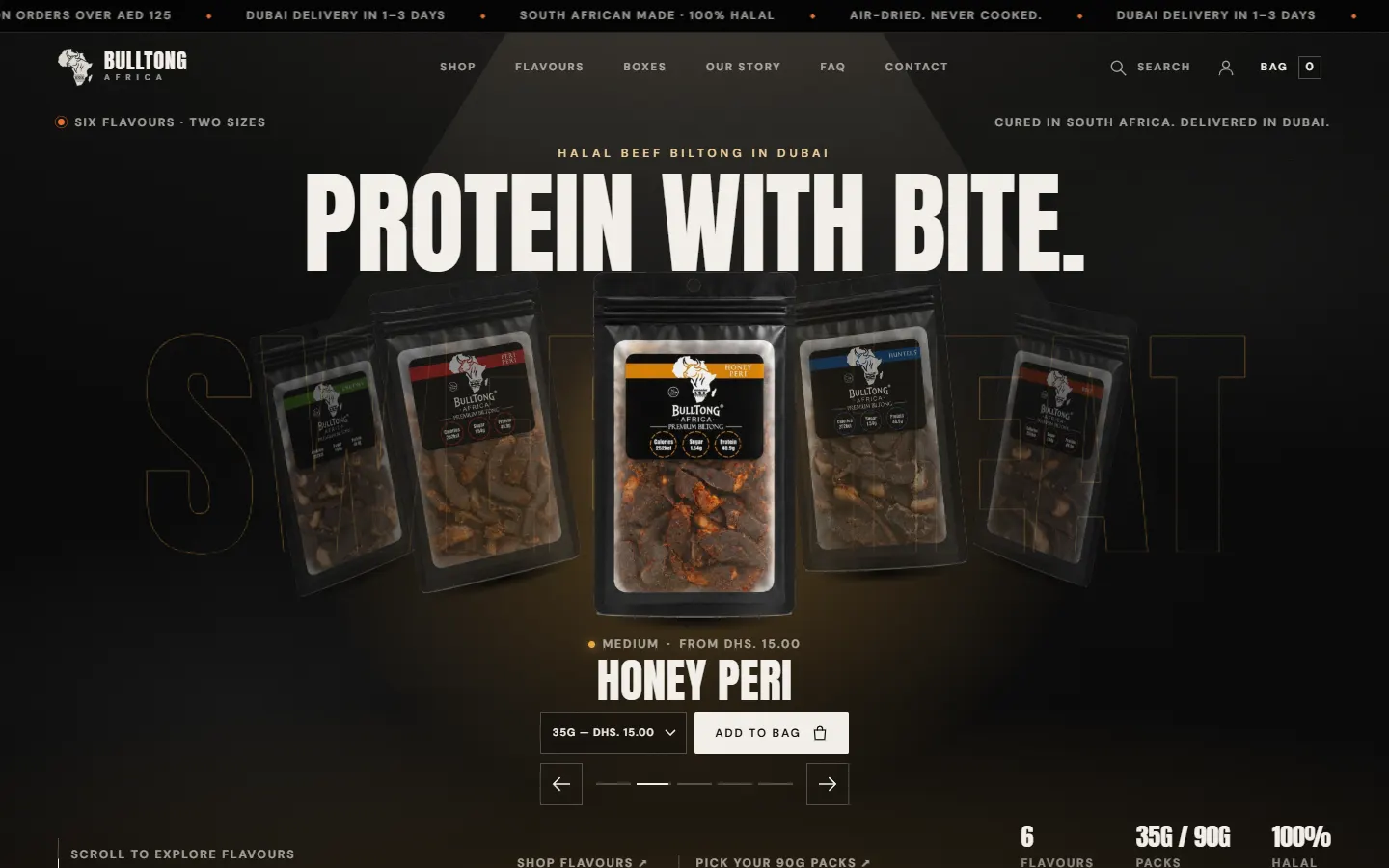
Bulltong Africa is the example. It sells South African biltong in Dubai, on a custom Shopify theme, not one from the Theme Store. The home page does a lot of explaining: how the meat is air-dried, how biltong differs from jerky, what a pack contains and where it comes from. A standard product grid has nowhere to put any of that.
Plenty of shops are well served by a good Theme Store theme, and that route costs less. If yours is one of them, we will tell you.
Something people have to understand or compare before they buy. Biltong and jerky look alike until someone tells you otherwise.
You are content for Shopify to run the back of the shop, and you want the front to look like nobody else’s.
Our example has six flavours in two sizes. Thousands of products with deep filtering is different work, and we cannot show you that yet.
We work on Shopify. If you are committed to something else, we are the wrong people to ask.
Changing it would spend money on a problem you do not have.
On Bulltong, a carousel of flavours comes with a size select and Add to bag, so someone who already knows what they want can stop there. On a phone they still share the first screen.
A comparison with jerky, the nutrition figures from the pack label, how the drying works. Each is a section of the theme, with its own place in the page.
A small script of its own. It works out how far the bag is from free Dubai delivery and shows that as a progress bar, in the sticky bar and on product pages. The ten-step heat rating on those pages is a separate thing.
A page for mixing any six packs, with a plus and a minus for each flavour and its heat shown beside it.
A Shopify theme is Liquid, CSS and JavaScript, and that is what we work in.
What is it, and what does a first-time buyer not know yet? The sections of the theme come out of those answers.
You add things to the bag on your own phone. We talk about what felt slow or unclear.
Sections, styles and scripts of its own, with structured data for search engines.
A new flavour, a new box, a page for the season. We keep caring for it after it goes live.
No. It is the platform we work on and the only one we can show you. If you are set on something else, a specialist in that platform will serve you better.
No. Bulltong runs on a custom Shopify theme, not one from the Theme Store. Shopify’s own record of that theme carries no Theme Store id, and its styles and scripts carry the brand’s name.
Yes. Products and orders stay in Shopify’s admin, where you would expect to find them. Changes to the theme itself, such as a new section, can be arranged with us.
Often, within what a theme can do. Bulltong’s free-delivery meter and its mix-your-own page are theme work. Anything that has to change the checkout itself needs a longer conversation.
We price a store after a first conversation, once we know the range and what the theme has to do. There is no rate card. Timing depends on the scope, and the form asks when you would like it.
Tell us about the product and the people who buy it, and we can talk about what the store should do.
say hello